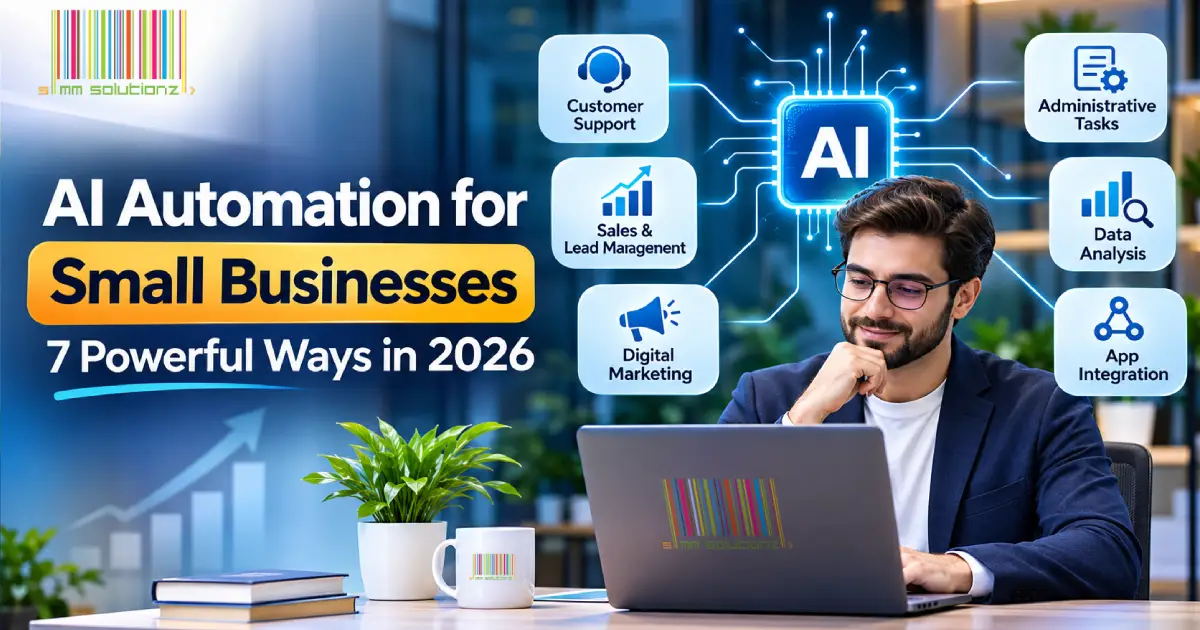
Artificial intelligence is changing the way businesses operate, communicate with customers, and manage everyday tasks. In 2026, AI automation for small businesses is becoming an important part of digital transformation. Companies are increasingly using intelligent software to reduce repetitive work, improve productivity, and make better business decisions.
Small businesses often operate with limited budgets and smaller teams. Managing customer enquiries, processing information, handling marketing activities, and maintaining daily operations can consume valuable time. AI-powered automation offers practical ways to simplify these processes without requiring businesses to hire large teams or invest in complicated technology.
Implementing AI automation for small businesses allows companies to manage routine operations more efficiently while improving customer experiences. Even businesses with limited resources can use affordable AI solutions to streamline everyday activities.
From automated customer support to intelligent workflow management, AI is helping small businesses become more efficient and competitive. Understanding how these technologies work can help business owners identify opportunities to improve their operations in 2026.
What Is AI Automation for Small Businesses?
AI automation refers to using artificial intelligence technologies to perform tasks that traditionally require manual effort. Unlike basic automation, which follows fixed instructions, AI-powered systems can analyse information, recognise patterns, understand language, and generate recommendations.
For example, a traditional automated system might send the same confirmation email whenever someone submits a contact form. An AI-powered system can analyse the enquiry, identify the customer’s requirements, categorise the request, and prepare a relevant response for review.
AI automation for small businesses can support several operational areas, including:
- Customer service and enquiry management.
- Email communication and follow-ups.
- Marketing content creation and planning.
- Sales lead management and qualification.
- Data analysis and business reporting.
- Document processing and administrative tasks.
- Internal workflow and task management.
Why AI Automation Is Becoming Important in 2026
Business competition continues to increase, and customers expect faster communication, convenient services, and personalised experiences. Small businesses need practical ways to meet these expectations while controlling operational costs.
According to the OECD report on AI adoption among small and medium-sized enterprises, businesses are increasingly exploring ready-to-use AI applications, while more advanced integration remains an ongoing challenge.
This demonstrates that AI is no longer limited to large technology companies. Smaller organisations can also use accessible AI solutions to improve everyday business activities.
7 Powerful Ways AI Automation Can Transform Small Businesses
1. Automating Customer Support
Customer support is one of the most practical applications of AI automation. Businesses receive questions about products, pricing, delivery, appointments, and services throughout the day.
AI-powered chatbots can answer common questions, guide website visitors, collect customer information, and direct complex enquiries to the appropriate team member.
For example, an online store can use an AI chatbot to help customers understand product features, check frequently asked questions, and find relevant information without waiting for a support representative.
With AI automation for small businesses, customer enquiries can be handled more efficiently through intelligent chatbots, automated responses, and organised support workflows.
This approach can improve response times and allow employees to concentrate on more complicated customer issues.
2. Improving Sales and Lead Management
Following up with potential customers is essential for business growth. However, manually tracking enquiries and remembering follow-up dates can become difficult when a business receives multiple leads every day.
AI automation can help businesses organise incoming enquiries, classify leads according to their requirements, prepare follow-up messages, and update customer relationship management systems.
AI automation for small businesses also helps sales teams organise customer information, prioritise enquiries, and maintain consistent follow-up communication.
These workflows help sales teams maintain better communication and reduce the chances of overlooking potential customers.
3. Making Digital Marketing More Efficient
Marketing requires consistent planning, content creation, audience research, and performance analysis. AI tools can support these activities by helping businesses prepare content ideas, generate initial drafts, analyse campaign data, and organise marketing workflows.
Businesses can use AI to assist with:
- Blog topic research and content outlines.
- Social media content planning.
- Email marketing drafts.
- Advertising copy ideas.
- Keyword research and SEO planning.
- Marketing performance summaries.
Using AI automation for small businesses in marketing can reduce repetitive work and help teams maintain a consistent content publishing schedule.
Human review remains important to ensure that published content is accurate, relevant, original, and consistent with the brand’s identity.
4. Streamlining Administrative Tasks
Administrative work can consume a significant amount of time in small organisations. Tasks such as organising documents, extracting information, preparing reports, and managing routine communication can often be simplified through automation.
AI-powered document processing can extract relevant information from invoices, forms, and business documents. Automated workflows can then transfer approved information into spreadsheets, databases, or business applications.
Small organisations can benefit from AI automation for small businesses by reducing manual data entry, organising documents, and simplifying administrative workflows.
By reducing repetitive work, employees can spend more time on activities that require experience and decision-making.
5. Improving Business Data Analysis
Business owners need accurate information to understand performance and identify opportunities. However, analysing large amounts of sales, customer, and operational data manually can be challenging.
AI-powered analytics tools can help identify patterns, summarise reports, compare performance, and highlight unusual changes in business activity.
For example, a retailer can analyse historical sales data to understand which products perform well during particular periods. These insights can support inventory planning and purchasing decisions.
AI automation for small businesses makes it easier to transform operational data into useful insights that support better planning and informed decisions.
6. Automating Email and Communication Workflows
Email remains an important communication channel for many businesses. AI automation can help categorise incoming messages, summarise long conversations, prepare response drafts, and organise follow-up tasks.
Businesses can also create automated workflows for appointment confirmations, enquiry acknowledgements, order notifications, and customer updates.
These processes help maintain consistent communication while reducing repetitive administrative effort.
7. Connecting Different Business Applications
Many small businesses use separate applications for sales, accounting, customer management, marketing, and project tracking. When these applications do not communicate with each other, employees often need to enter the same information multiple times.
Workflow automation platforms and API integrations can connect different business applications and transfer information automatically.
For example, when a customer submits a website enquiry, an automated workflow can create a CRM record, notify the sales team, and prepare a follow-up task.
Combining APIs, workflow platforms, and AI automation for small businesses creates connected systems that reduce repetitive tasks across different applications.
Popular AI Tools and Technologies for Business Automation
Businesses have access to different AI platforms and automation technologies. The right choice depends on the tasks that need to be automated, existing software, security requirements, and available budget.
ChatGPT
ChatGPT can assist with content preparation, research, customer communication drafts, data analysis, and business planning. It can also support connected workflows when compatible integrations are available.
Microsoft Copilot
Microsoft Copilot brings AI assistance into supported Microsoft applications. Businesses can use it to help prepare documents, analyse information, summarise communications, and improve productivity.
Zapier
Zapier connects different applications and automates workflows between supported services. It can help businesses transfer information, trigger notifications, and manage repetitive processes.
Make
Make provides visual workflow automation for connecting applications and designing multi-step business processes. It is useful for businesses that need more detailed workflow logic.
n8n
n8n is a workflow automation platform that supports integrations, API connections, and AI-powered workflows. It can be suitable for businesses that require greater control over their automation infrastructure.
Important Considerations Before Implementing AI Automation
Although AI automation offers several benefits, businesses should evaluate their requirements before implementing new systems. Choosing tools without a clear objective can increase costs and create unnecessary complexity.
Consider the following factors before starting:
- Identify repetitive tasks: Start with processes that consume significant employee time.
- Set clear objectives: Define what improvement you expect from automation.
- Protect business data: Review privacy policies, access permissions, and security controls.
- Check integration options: Make sure new tools work with your existing applications.
- Maintain human supervision: Review important AI-generated outputs before taking action.
- Measure performance: Monitor time savings, accuracy, customer experience, and operating costs.
Cybersecurity is particularly important as businesses introduce AI into their operations. Businesses should establish appropriate permissions, monitor automated activities, and protect sensitive information.
For additional guidance, explore NIST’s AI Risk Management Framework, which provides guidance for managing risks associated with artificial intelligence systems.
The Future of AI Automation for Small Businesses
AI automation is expected to become increasingly integrated into everyday business software. More organisations are exploring AI assistants, intelligent workflows, predictive analytics, and systems that can coordinate tasks across multiple applications.
One important development is agentic AI. These systems can work towards defined objectives by interacting with connected tools and performing multiple steps within an approved workflow.
However, successful implementation will depend on appropriate permissions, reliable data, security measures, and human oversight. Businesses should focus on solving real operational problems rather than adopting AI simply because it is a popular technology trend.
How to Get Started with AI Automation
Choosing the right AI automation for small businesses requires understanding operational challenges, selecting appropriate technologies, and measuring the results of each implementation.
A practical starting approach includes:
- Review existing business operations and identify repetitive tasks.
- Select one process that would benefit from automation.
- Compare suitable AI tools and integration platforms.
- Build and test a small automation workflow.
- Monitor accuracy, security, and performance.
- Expand the workflow after confirming its business value.
Starting with a small project helps businesses understand the practical benefits of automation before making larger technology investments.
Conclusion
AI automation for small businesses is creating new opportunities to improve productivity, customer service, marketing, and operational efficiency in 2026. From automated customer enquiries to intelligent data analysis, businesses can use AI technologies to reduce repetitive work and make better use of their resources.
The best approach is to start with a clearly defined business problem, select suitable tools, and gradually introduce automation into existing workflows. With proper planning, security, and human supervision, AI can become a valuable part of long-term business growth.
Businesses looking to improve their technology infrastructure should explore suitable software solutions, application integrations, and automation strategies that align with their operational goals.
To explore professional technology solutions and discover how digital services can support your business, visit MM1 Solutions.
Frequently Asked Questions
What is the best AI automation for small businesses?
The best solution depends on business requirements. Customer support automation, email management, lead tracking, marketing workflows, and document processing are practical starting points for many small businesses.
Can small businesses afford AI automation?
Yes. Many AI platforms offer free or affordable entry-level plans. Businesses can begin with simple automation tools and expand their systems as their requirements grow.
Does AI automation replace employees?
AI automation is primarily useful for handling repetitive and time-consuming tasks. Human employees remain essential for customer relationships, strategic decisions, problem-solving, and reviewing important outputs.
Is AI automation secure for business operations?
AI automation can be used securely when businesses select reputable platforms, configure appropriate access permissions, protect sensitive information, and regularly review their integrations and security policies.
How can a business get started with AI automation?
Start by identifying a repetitive process, evaluating suitable tools, testing a small workflow, and measuring the results. Expand automation gradually after confirming that the process is reliable.